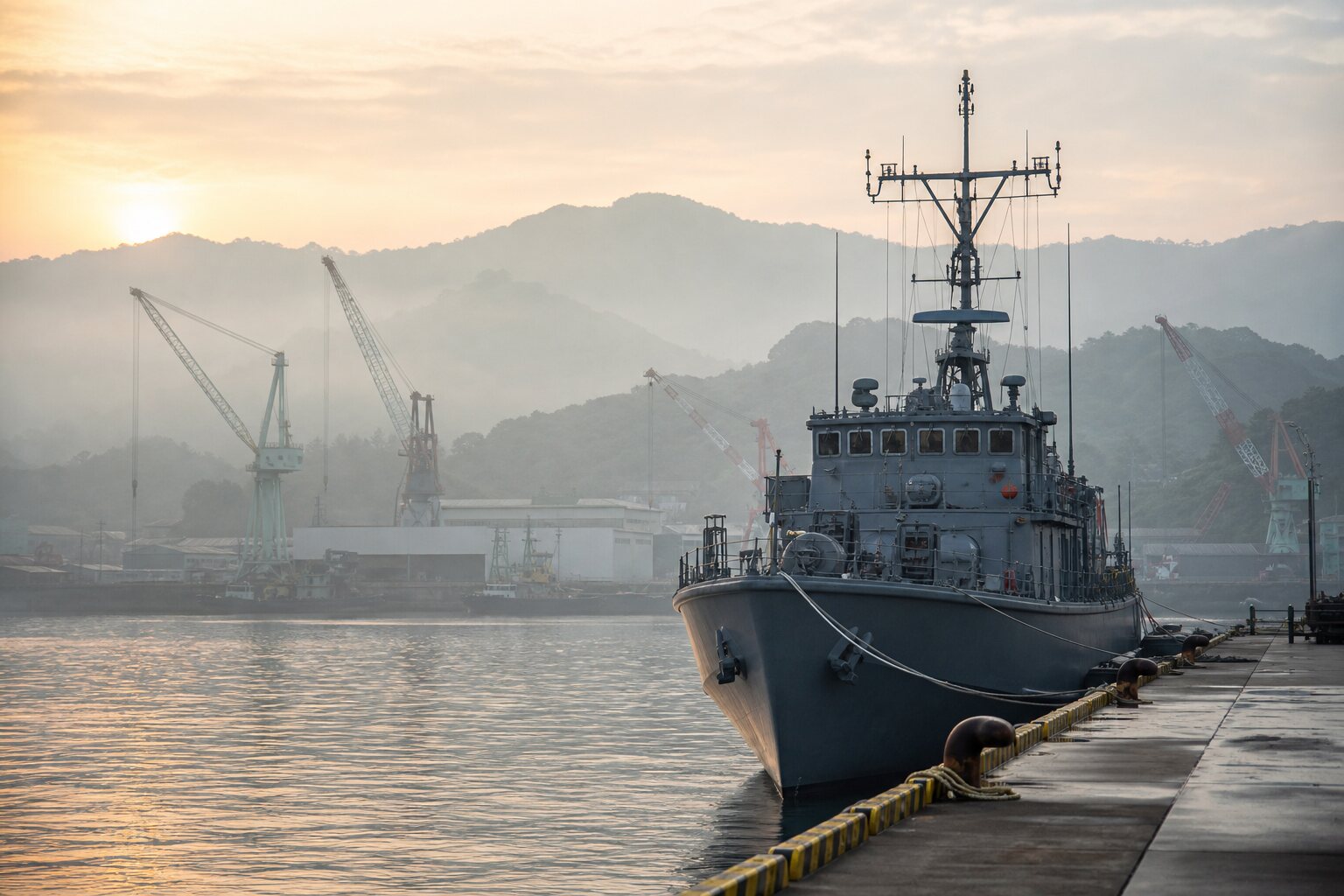
A port is more than a place name
A home port links maintenance, training, supply, administration and the social geography of a deployment. It helps explain why a ship history moves between a vessel, a base and a wider command structure.
Do not turn setting into scene
The archived Sasebo route is useful evidence of what former readers wanted to know. It is not a license to invent a day on the pier or a personal memory. The page therefore treats Sasebo as a documented setting and marks the point where a deck log would be needed for more detail.
Follow the port through records
A researcher can pair the DANFS summary with deck logs, command histories and catalog descriptions. The result is not a complete travel narrative. It is a more defensible account of what the port made possible.
A documented transfer in April 1956
Phoebe departed Long Beach on March 4, 1956, reached Yokosuka on April 4 and shifted to Sasebo on April 10. The official history identifies Sasebo as the ship's permanent base after that move. These dated points establish a transfer; they do not describe the weather, route between ports or activity on the pier.
The base matters because the next eight years of minehunting and mine-warfare work are described from that western Pacific setting. Sasebo offers a stable organizing point for exercises and port calls that otherwise look like a disconnected list. It helps explain why Japan, Korea, Taiwan, Okinawa and the Philippines appear within one service history.
Home port links administration and movement
A home port can shape supply, upkeep, mail, training and command relationships, but each of those functions needs its own evidence. Modern descriptions of a naval support facility should not be projected backward onto 1956. Institutions, facilities and responsibilities change, even when the geographic name remains the same.
For Phoebe, the safe statement is that Sasebo was the permanent base named by the official ship history. A command history, base newspaper, repair record or dated deck log could expand that picture. Until such records are examined, the page uses the port as a supported setting and avoids inventing a detailed shore routine.
Research the port without losing the ship
Start with the vessel's arrival and departure entries, then add local records that match the same period. Note who created each source. A ship's deck log records the ship's official daily activity; a base record may explain a facility or command; a personal photograph may preserve an experience. They answer related but different questions.
A map should use supported points and visible uncertainty. It can mark Sasebo as a base, a dated exercise location when one is documented and a named port call when the history supplies it. It should not connect those points with an exact voyage line unless a sequence of logs provides the intervening positions.
Research worksheet
Put this method to work
A port research folder can be organized by ship records, base records, photographs and personal material. The categories prevent a modern facility page from being used as evidence for a 1950s arrangement and keep a family image from being treated as an official movement report. Record every place name as the source gives it, then add a normalized geographic field for mapping. That preserves historical wording while allowing consistent search and display.
Continue the research
Follow the evidence into the next question
Follow the dated move through the service timeline.
Build a cautious map with the western Pacific route method.
For the lived setting, compare records with the daily-life framework rather than inventing a scene.