People & Heritage / source-led essay
Denton County Local History Museum Guide
A practical guide to using a Denton County local history museum for genealogy and research, from exhibits to deeds, probate, census and cemetery records.
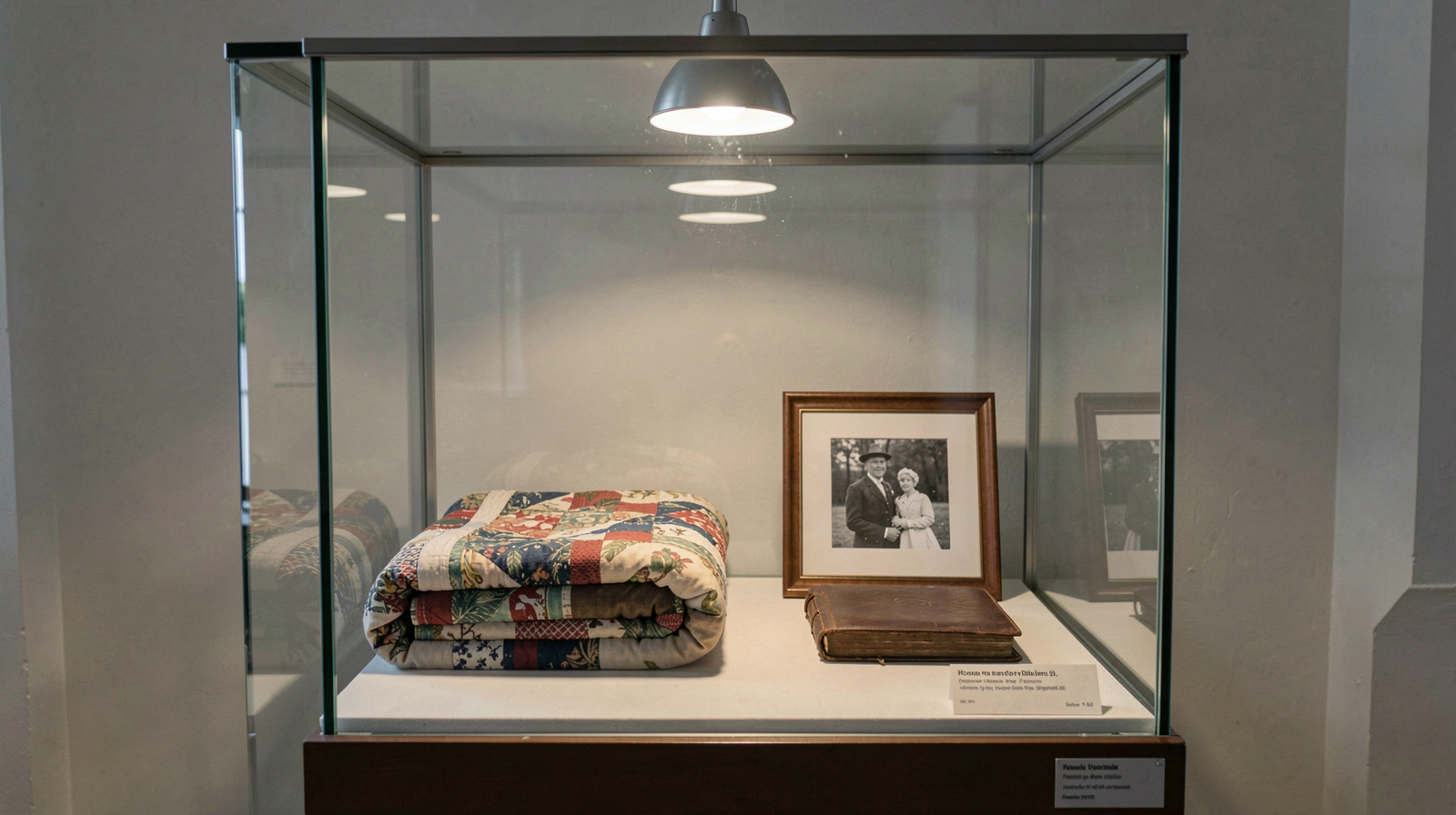
A local history museum in Denton County, Texas, is a research institution as much as a display space. Its collections hold the paper trail that courthouse fires, faded ink and scattered family papers left behind, and its exhibits are arranged so a visitor can read that trail in an afternoon. The Denton County Historical Museum in Denton is the main starting point for anyone working on county families, and its published material explains what the surviving collections hold and how to read an exhibit.
What does a Denton County local history museum hold?
County collections look modest from the doorway: a few cases, a wall of framed photographs, a shelf of ledgers. The value is in the ledgers. Local museums in North Texas typically keep bound deed volumes, probate files, tax lists, school registers, cemetery transcriptions and family photograph albums. A folded quilt in a glass case and a closed ledger beside it are not decoration. The quilt documents a family name and a date range, and the ledger documents land transfers on the courthouse square.
A museum of this kind also keeps the county's printed histories. A shelf of thin paperbacks with brown covers, most of them local history reprints, is a working reference collection. Staff and volunteers can tell a visitor which volumes are reliable and which were assembled from memory.
The Denton County Historical Museum, run by the Denton County Historical Commission and the local historical society, is the reference point for this material. Its online pages describe the county's surviving collections and how to read an exhibit, which is useful before a first visit. A reader who wants to know what a county museum actually keeps can start with the museum's own account of its holdings.
When did the key events in Denton County happen?
The first families came to the Blackland Prairie before there was a county to live in. They cleared land, built cabins, and waited for a government to catch up with them. County organisation followed, then the railroads arrived, then came the cotton years and the growth of towns.
The dates the record gives us run in a rough sequence. Settlement on the prairie came first, in the years before county government existed. County organisation followed, with a courthouse and a clerk to keep the books. The railroads reached the county in the later nineteenth century and reshaped the towns along their lines. Cotton dominated the farm economy into the twentieth century. Each of these phases left a different kind of document, and each document answers a different question.
A family historian who knows the sequence can date a photograph, a deed or a letter by the phase it belongs to. A cabin photograph belongs to the settlement years. A deed volume with a courthouse stamp belongs after organisation. A railroad depot photograph belongs after the line arrived.
How do you read a museum exhibit as evidence?
An exhibit is an argument made with objects. The label tells you what the curator believes the object proves, and the object itself tells you what it can prove. Read the label first, then look at the object, then decide whether the two match.
A framed photograph with a family name and a date is strong evidence of a family's presence in a place at a time. A quilt with a stitched name is weaker evidence, because quilts were often made later than the events they commemorate. A ledger with entries in several hands is strong evidence of transactions, but the handwriting changes mean several clerks worked on it.
The same rule applies to the museum's own published material. A page that says a collection holds a folded quilt, a closed ledger and a framed photograph is telling you what survives, not what happened. The gap between the two is where research begins.
Which records carry the most weight for family research?
Every family historian working in Denton County runs into the same fork in the road: a federal census return that lists a household, and a gravestone inscription that names the same people differently. Census returns and cemetery lists are the two most consulted sources, and they disagree often enough that the disagreement itself is useful.
Census returns give a household, an age, a birthplace and an occupation on a single date. Cemetery lists give a name, a birth year, a death year and sometimes a family relationship. When the two conflict, the census usually wins on age and birthplace, and the gravestone usually wins on the spelling of a name as the family wanted it remembered.
Deed and probate records carry more weight than either, because they were created for legal purposes and kept by a clerk. The courthouse square in Denton has watched a hundred thousand land transactions pass across its counters, and every one of them left a paper trail. A probate file names heirs, which is often the only document that lists siblings together.
Local history reprints carry the least weight. They are useful for context and for names to search, but they are secondary sources and should be checked against the records they cite.
What does the county's landscape tell a researcher?
Denton County sits in North Texas, on the northern edge of the Dallas-Fort Worth metroplex, and its shape has been redrawn more than once since the first surveyors ran their lines. The county's geography divides into two belts: the Blackland Prairie, with its dark ploughed soil, and the Cross Timbers, with its line of bare post oaks.
Settlement followed the soil. Prairie land was cleared for cotton and grain, and the towns grew along the railroads that served the farms. The Cross Timbers held timber for cabins and fuel, and farms there were smaller and more scattered. A researcher who knows which belt a family lived in can predict what kind of records to look for. Prairie families appear in cotton marketing records and railroad shipping lists. Cross Timbers families appear more often in timber and livestock records.
County boundaries matter for the same reason. A family that lived near a line may appear in the records of two counties, and a deed that seems to be missing from Denton County may sit in a neighbouring county's books.
How should a first visit be planned?
Call or check the museum's hours before travelling, because small county museums are often staffed by volunteers and open on limited days. Bring a notebook and a pencil, since pens are usually barred near documents. Bring the names, dates and places already known, so staff can point to the right shelf.
Ask three questions on a first visit. What does the museum hold for this surname? What does it hold for this place? What does it hold for this date range? The answers will usually narrow the search to one or two collections.
Photography rules vary. Some museums allow photographs of documents without flash, and some do not. Ask before opening a phone camera.
A local history museum is not a courthouse and not an archive. It is a place where the county's paper trail has been gathered, labelled and made readable. Used that way, it saves months of scattered searching.